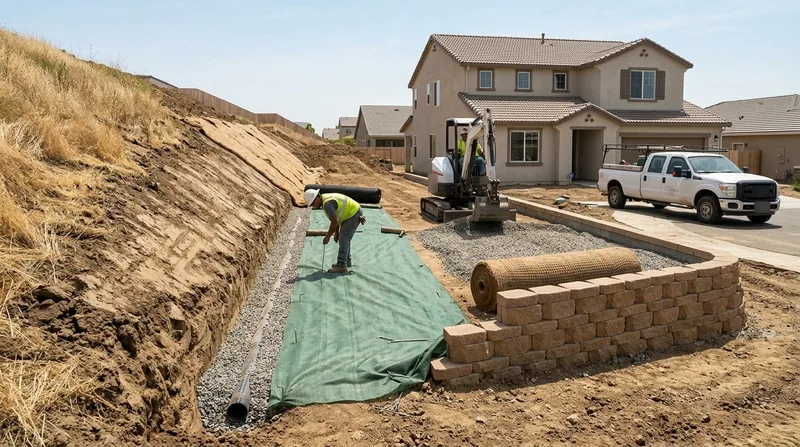




Slope Stabilization & Erosion Control in Stockton
Stockton sits on the flat eastern edge of the Delta, where the Calaveras River, the deep-water channel and a web of sloughs cut through dense adobe clay and peat over a high water table. That ground swells hard in winter rains and shrinks back in the dry summer, and slough-bank lots in Brookside, Spanos Park and Weston Ranch feel it first: bank soil sloughs away, fence lines drop, and docks start to lean. Slope Stabilization & Erosion Control in Stockton is how we stop that movement before it reaches a foundation, a pool deck or a seawall. We build terraced walls, set geogrid reinforcement and install erosion control that holds the bank through both the wet season and the dry one. If the bank is already moving, start with leaning and collapsed wall repair before the grade change gets worse.
Why Slope Stabilization Matters on Stockton's Slough Banks and Levee-Side Lots
Most of Stockton is level, so the slopes that matter are the ones cut for water: slough banks, Calaveras River edges, levee-side lots and the raised beds and pool-deck grade changes behind 1990s and 2000s tract homes. The soil under them is heavy adobe clay and peat sitting on a high water table. When winter rain soaks that clay, it expands and pushes outward; when summer dries it, the soil shrinks and cracks. A bank with no reinforcement loses a few inches a season until a fence post, a dock footing or a patio edge is hanging in air.
- Bank soil sloughs into the slough after heavy rain, taking turf, shrubs and topsoil with it.
- Fence lines and dock footings settle and lean as the clay beneath them shrinks in summer.
- Water ponds against the toe of a slope because the bank has no drainage outlet.
- Existing railroad tie or timber borders rot out and stop holding the grade change.
- Cracks open in pool decks and patio slabs where the soil moves under the edge.
We look at the whole bank, not just the failing section, because a fix at the toe without reinforcement uphill usually just moves the problem ten feet back.
Key info: On a Brookside waterfront lot, we commonly find the original bank grade was never reinforced, only landscaped. After two wet winters, the turf edge has retreated two to three feet toward the fence. A terraced segmental block wall with geogrid and a drainage chimney stops that retreat and protects the dock footing behind it.
Stockton's building department sets the permit threshold, and walls above roughly four feet from the footing, or walls carrying a surcharge, often need engineered drawings. Check the City of Stockton's building permit guidance at stocktonca.gov before any bank work starts.
How We Stabilize a Stockton Slope: Step by Step
Every bank is different, but the sequence we follow on Stockton and Lathrop slough lots is consistent. We read the grade, find where the water is going and build the reinforcement to match the soil we actually hit, not the soil on a generic plan. On peat-heavy lots near the deep-water channel, that often means over-excavating to reach competent ground before we set the base.
- We walk the bank and mark the failure points, the water path and any structures within influence.
- We dig test holes to confirm clay depth, peat layers and the water table before pricing the fix.
- We strip the sloughed soil and shape the bank to a stable angle or terrace it.
- We set a compacted base and build the wall or reinforced slope from the toe up.
- We install geogrid in lifts and tie it back into the retained soil as the wall rises.
- We add a drainage chimney, outlet and surface erosion control so water leaves the bank.
- We restore the grade, seed or sod the disturbed area and walk the finished bank with you.
For segmental block terraces and reinforced beds, the material and reinforcement details live on our block and segmental retaining walls page.
Key info: On a Weston Ranch lot backing the slough, the bank had lost about eighteen inches over two winters and the rear fence posts were leaning. We terraced the bank in two segmental block lifts, set geogrid in each lift and ran a drainage chimney to a pop-up outlet in the yard. The fence line came back plumb and the bank has held through two wet seasons.
Slope Stabilization Methods We Use Around Stockton
The right approach depends on bank height, soil, water and what sits above the slope. We match the method to the lot, and we tell you when a simpler fix will hold and when it will not. The table below covers the approaches we use most on Stockton, Manteca and Tracy banks.
| Approach | Description | Best for |
|---|---|---|
| Terraced segmental block walls | Two or more low block lifts stepping up the bank, each tied back with geogrid and drained. | Slough-bank lots and waterfront yards in Brookside and Spanos Park. |
| Geogrid-reinforced slope | Layered grid in compacted lifts that ties the face of the slope back into stable soil. | Taller banks where a full wall would crowd the yard or dock. |
| Boulder toe and rock revetment | Embedded rock at the toe that absorbs wave and current action and holds the bank foot. | Banks with direct water exposure on the Calaveras River and Delta sloughs. |
| Surface erosion control | Grading, erosion blanket, seeding and sod on the disturbed face above the reinforcement. | Any bank after grading, to stop rain from cutting channels in bare clay. |
| Drainage chimney and outlet | Gravel and filter fabric behind the wall that collect water and pipe it to a safe outlet. | Clay and peat banks where hydrostatic pressure pushes walls out. |
We pair the reinforcement with drainage every time, because on Stockton's clay an undrained bank will push out a wall no matter how heavy the block is.
Slope Stabilization & Erosion Control Cost in Stockton: What to Expect
We start every job with a free on-site estimate, because a bank cannot be priced from a photo. The number depends on bank height and length, how deep the peat runs, how close the work sits to a dock, pool or foundation, and how much soil has to be stripped and hauled off. Access matters too: a backyard bank reachable by machine prices differently from one behind a pool and a fence line.
Small, low banks with a single terrace and a drainage outlet land at the lower end. Taller slough banks that need geogrid, rock at the toe and engineered drawings run higher, and jobs in the $8,000 to $25,000 range are common on waterfront lots. We give you the breakdown before we start, so you know what the reinforcement, drainage and restoration each cost. Our full pricing overview has more detail on how we structure a quote.
Get two or three estimates and compare scope, not just the bottom line. A low bid that skips drainage or geogrid is not the same job as one that includes them, and on adobe clay that difference shows up in the first wet winter.
Hiring a Retaining Wall Contractor Near Stockton: What to Check
Bank work is structural work, and the contractor you pick should be able to show you the permits, the insurance and the references behind the bid. Ask questions before you sign, and do not let urgency push you past the basics. A fully insured contractor will hand over a certificate of insurance without a fuss.
- Confirm the contractor is fully insured, and ask for the certificate of insurance in writing.
- Get two or three written estimates that list reinforcement, drainage and restoration as separate lines.
- Ask for references from jobs on slough banks or waterfront lots, not just flat-yard walls.
- Check with the City of Stockton building department on whether your wall needs a permit or engineered drawings.
- Ask how the contractor will protect trees, fences and docks during excavation and hauling.
If you are ready to talk through your bank, contact us for a free estimate and we will walk the slope with you.
Slope Stabilization & Erosion Control in Stockton: Pricing Guide
| Service | Price | Details |
|---|---|---|
| Low bank terrace and drainage outlet | Starting at $3,500 | Includes grading, one low block terrace, drainage outlet and seed; bank height moves the price. |
| Terraced segmental block bank stabilization | Starting at $8,000 | Two or more geogrid-reinforced lifts with drainage chimney; bank length and access drive cost. |
| Boulder toe and rock revetment | Starting at $6,500 | Embedded rock at the bank foot for water exposure; rock size and machine access affect the total. |
| Geogrid-reinforced slope with engineered drawings | On estimate | Taller or tiered banks need an on-site look and engineering before a number is given. |
| Travel | Included | in Stockton and surrounding areas, no separate call-out or mileage fee. |
| Estimate | Free | Response within 24h at (209) 290-1372, no obligation to book. |
Indicative pricing, the exact cost depends on square footage, finish, and site access. Free personalized estimate within 24h at (209) 290-1372.


