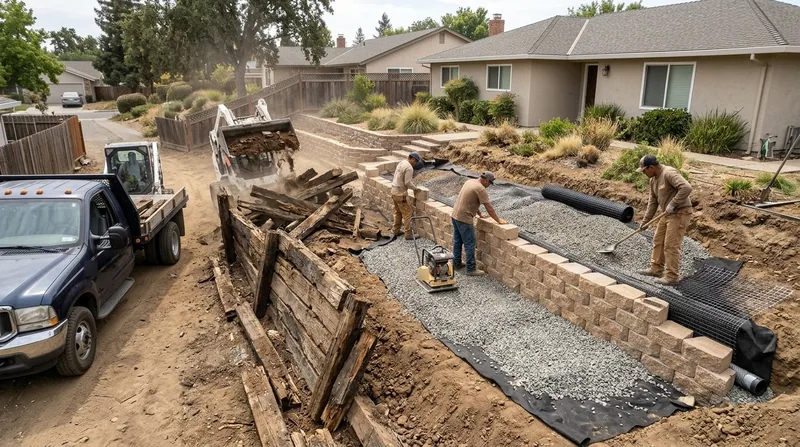




Stockton sits on the flat eastern edge of the Sacramento-San Joaquin Delta, where the Calaveras River, deep-water channel and a web of sloughs cut through dense adobe clay and peat. That ground swells hard in winter rains and shrinks back in the dry summer heat, and it has been quietly pushing out 1970s and 1980s railroad tie walls for decades. If you own a Miracle Mile cottage, a Country Club ranch or a waterfront lot out in Brookside, those creosote-soaked ties are probably leaning, rotting at the base or bleeding tar into the soil. Railroad Tie Wall Replacement in Stockton means we pull the old ties, haul the creosote-treated wood away legally, fix the drainage underneath and rebuild the wall in segmental block, concrete or natural stone that will hold up to this soil. We handle the whole job, from demolition to the last cap block, and we start with a free on-site look. You can see how we approach a full rebuild on our retaining wall replacement page.
Why Old Railroad Tie Walls Fail Faster in Stockton's Delta Soil
Railroad ties were the cheap answer in the 70s and 80s, and plenty of them are still holding up planter beds and grade changes across Stockton. The problem is that creosote-treated timber rots from the inside out once it sits in wet clay, and the same expansive soil that cracks driveways heaves those ties out of line. Add a high water table and no gravel backfill, and the wall starts to lean within a season or two.
- Creosote-treated ties leach tar and preservatives into garden soil and stain nearby concrete.
- Timber rots at the ground line where moisture never drains, so the base gives out first.
- Adobe clay and peat swell in winter and shove undrained walls forward, cracking the tie ends.
- Most old tie walls were built with no gravel backfill or weep path, so water stacks up behind them.
- Termites and fungal decay move through soft tie wood fast in our warm, damp ground.
Once a tie wall is bulging or the top course has separated, patching it just buys a season, and a full rebuild is the cheaper path.
Key info: A homeowner in the Magnolia district had a 3-foot tie planter along the side yard that had rotted through and was staining the neighbor's fence with creosote. We pulled 22 ties, hauled them to a permitted disposal site and rebuilt the bed in segmental block with a gravel drainage core. Check the City of Stockton's building permit rules before you start any wall near a property line: stocktonca.gov building division.
How We Tear Out and Rebuild a Tie Wall in Stockton
We do not just stack new block on top of rotten ties. The old wall comes out completely, the soil behind it gets corrected, and the new wall goes in with drainage that actually works in Delta clay. Here is the sequence we follow on a typical Stockton tie wall replacement.
- We walk the site, check the slope and soil, and confirm where the property line and any utilities run.
- We cut and pull the old ties, bag the creosote-treated wood and haul it to a permitted disposal facility.
- We excavate to a stable base and compact a crushed-rock footing that will not move in expansive clay.
- We install a gravel backfill and perforated drain pipe that carries water away from the wall face.
- We set the new wall in segmental block, poured concrete or natural stone, course by course, with proper batter.
- We cap the wall, backfill and compact in lifts, then clean the site and walk the finished job with you.
If the old wall was holding a raised bed or a grade change on a Brookside waterfront lot, we also check the slough-bank side for erosion before we close it up.
Key info: A Spanos Park homeowner had a 40-foot tie wall holding up a raised patio behind the pool deck. The ties had heaved and the pool coping was cracking. We rebuilt it in segmental block with a full gravel drainage core and tied the new wall into the existing deck grade so water now runs to a pop-up drain instead of sitting against the house. See our retaining wall drainage work for the details.
Replacement Approaches We Use in Stockton
The right replacement depends on how tall the wall is, what it holds up and how the water moves on your lot. These are the four approaches we use most often when we take out an old tie wall in Stockton.
| Approach | Description | Best for |
|---|---|---|
| Segmental block | Interlocking block courses with gravel backfill and a drain core, built with slight batter. | Low garden and planter walls, raised beds, most residential replacements. |
| Poured concrete | Steel-reinforced concrete wall formed and poured on a compacted footing. | Taller walls, walls under a surcharge, driveway and structure support. |
| Natural stone or boulder | Gravity wall built from stacked rock, with gravel behind the face. | Slough-bank walls, landscape features, waterfront lots. |
| New timber wall | Pressure-treated landscape timber rebuilt with proper drainage and deadmen. | Budget-minded low borders where a natural wood look is wanted. |
We tell you which one fits your lot after we see the soil, the grade and what the wall is holding back.
Railroad Tie Wall Replacement Cost in Stockton: What to Expect
Most tie wall replacements in Stockton start around From $35 per square foot of wall face, and that figure moves with the wall height, the material you pick and how hard the old ties are to get out. A low 2-foot planter in Lodi sits near the bottom of that range, while a 5-foot wall holding a driveway or a slough bank pushes toward the top and may need engineering.
Access is the wild card. A tie wall tucked behind a pool cage in Brookside or against a fence in Weston Ranch takes more labor to demo and haul than one along an open side yard. Creosote disposal also carries a fee, since treated ties cannot go in the regular green waste stream. Taller walls, tiered walls and anything under a surcharge may need a permit and engineered drawings, which adds design cost.
Get two or three written estimates on the same scope so you can compare what is actually included: demolition, haul-away, drainage, block and cap. Our full pricing overview breaks down how we build a number.
Finding a Railroad Tie Wall Replacement Contractor Near Me in Stockton
Replacing a tie wall is a small job with real liability, because a failed wall can take out a fence, a pool deck or a neighbor's grade. Use the same checklist you would for any contractor working on your property, and do not skip the paperwork.
- Confirm the contractor holds a valid California contractor license and carries liability and workers' comp insurance.
- Get at least two or three written estimates that list demolition, disposal, drainage and materials separately.
- Ask for recent local references and go look at a finished wall in person if you can.
- Ask who pulls the permit if your wall is over the height threshold or holds a surcharge.
- Check any HOA rules on wall height, material and color before the crew shows up.
A contractor who answers these questions straight and puts the scope in writing is the one you want on a tie wall teardown.
Ready to get rid of a rotting tie wall? Call (209) 290-1372 or request a free estimate and we will take a look at your lot.
Railroad Tie Wall Replacement in Stockton: Pricing Guide
| Service | Price | Details |
|---|---|---|
| Low tie wall replacement (up to 3 ft) | Starting at $35/sq ft | Includes tie removal, creosote haul-away, gravel backfill and a new segmental block face. |
| Tall or surcharge wall replacement | Starting at $55/sq ft | Higher rate covers engineered design, concrete or block, and deeper footing for driveway loads. |
| Complex or large-scale job | On estimate | Tiered walls, tight pool-deck access and slough-bank work need an on-site look before pricing. |
| Creosote tie disposal | Included | Treated ties are hauled to a permitted facility, with the disposal fee built into the quote. |
| Travel | Included | In Stockton and surrounding areas, no separate call-out or mileage fee. |
| Estimate | Free | Response within 24h at (209) 290-1372, no obligation to book. |
Indicative pricing, the exact cost depends on square footage, finish, and site access. Free personalized estimate within 24h at (209) 290-1372.


